Water and Politics
Water covers nearly 3/4 of the surface of the planet; a figure which makes it seem like the most renewable resource with an inexhaustible supply (Harvey, 2018). However, the issue lies within the fact that most of this supply is inaccessible. Only 2.5% of the water on the planet is fresh, of which only 1% is accessible in rivers, lakes and underground (The World Health Organisation, 2001). The amount of usable freshwater is diminishing due to a myriad of forces including global warming and various forms of pollution.

Source: chaitanyaproducts.com
The Link between water and politics
You might be wondering - how is water related to politics? Water is the most precious resource on the planet; it is vital for human life, not only for survival but for fuelling economies, trade and innovation. This makes it inherently linked to politics. Many people do not have to question their ability to access water; it is seen as a basic resource and taken for granted. However, this is not the case for many others around the world; nearly two-thirds of the worlds population suffers from severe water scarcity during at least one month per year (Mekonnen and Hoekstra, 2016). Despite being an abundant resource, distribution is neither even or equitable, causing issues of scarcity for certain people and regions. So what would happen if a country’s water supply ran out? It would inevitably cause a collapse of the economy, a humanitarian crisis and political instability with the strong likelihood of violence and uprisings. Consequently, this is a question not taken lightly by those in power and has forged the way for hydro-politics.
Water has been the source of conflicts and tension throughout history. It is not a new concept. Moreover, it has been used as a strategic tool for ethnic and religious conflicts for millennia, shaping politics (Kreamer, 2013). For example, the Han Dynasty in China used water as a weapon in 204 BC by rupturing dams on the River Wei. Attacking water supplies was a common tactic used by the Romans to force their opponents to surrender as without a water supply there was no chance at survival (Pacific Institute, 2018). In more recent years, water resources have been put under greater stress due to factors such as climate change, rapid population growth and increased demand; resulting in water playing an ever important role in geopolitics and conflict. Every 3 years, the UN compiles a report on world water development. In 2009, the report concluded that water had the potential to cause major conflicts due to issues such as scarcity, climate change, human development and economic growth (UNESCO World Water Assessment Programme, 2009).
Due to water playing an ever important role in geopolitics and conflict, it has been termed by some as the next oil (Nilekani, 2007). The World Bank Vice President warned in 1995 that “if the wars of this century were fought over oil, the wars of the next century will be fought over water" (Otis, 2002). The depleting oil reserves can be compared to the issue of water scarcity and the conflicts directly associated with this. Unequal distribution, accessibility, exploitation and increasing costs of water sharing are all traits that make water comparable to oil. If the UN’s warnings are not heeded, we will see in the years to come if the comparison between water and oil was an accurate one.
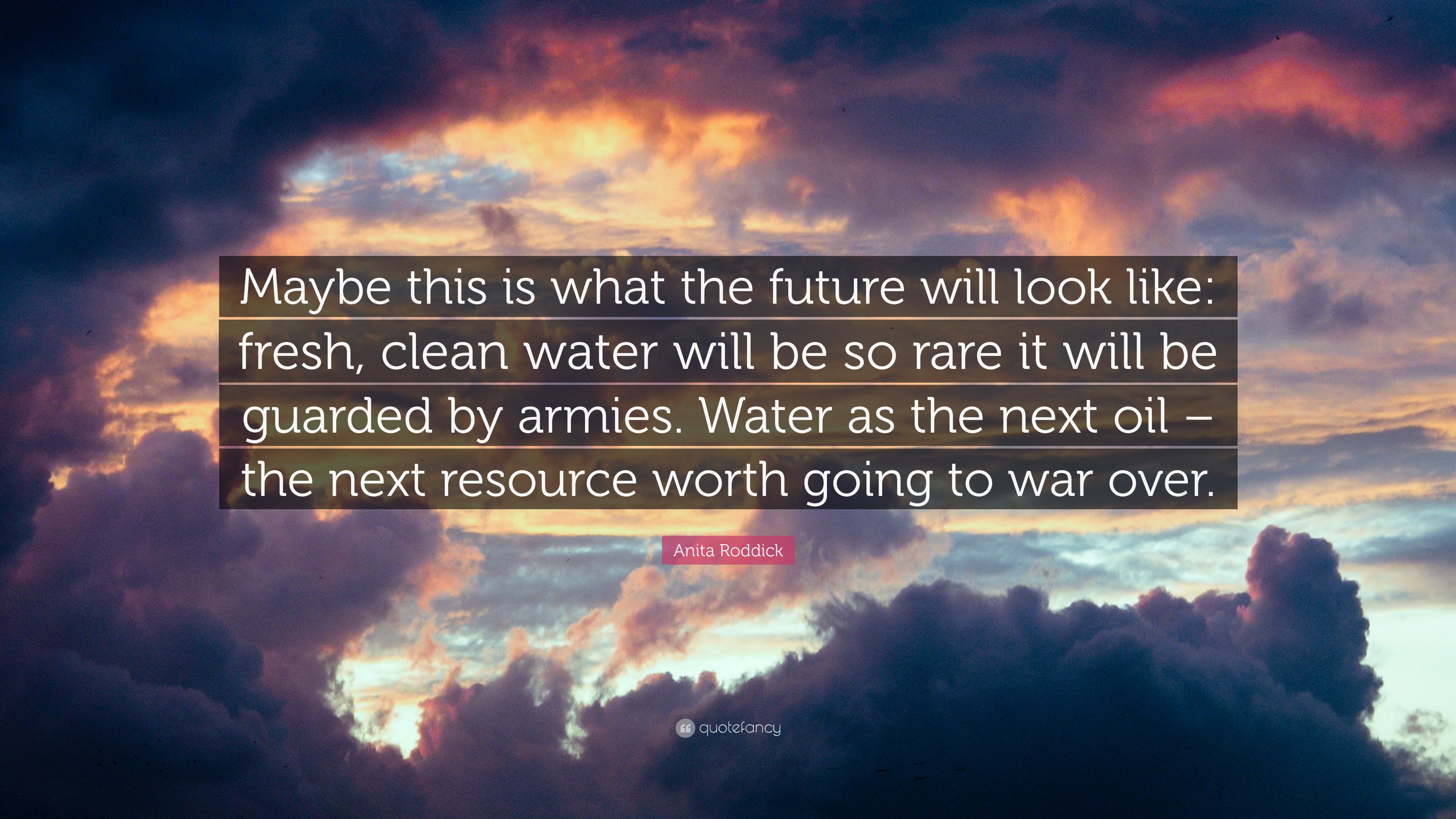
Quote by Anita Roddick. Source: (quotefancy.com)
My interest in this topic
Studying the Arab-Israeli conflict at university sparked my interest in water and politics and how they are linked. Initially, with only a limited background knowledge on the subject, I thought the conflict was over land and religion. However, throughout the course I gained a deeper understanding of the complexities and layers of this this extremely controversial, age old conflict. There are numerous factors contributing to the conflict, with water playing a significant role. It is argued that one of the key motives for the 6 day war in 1967 was gaining greater access to fresh water sources in the Jordan river system (Asser, 2010). The Jordan river is a transboundary river, meaning that it is shared by multiple countries and its waters are essential to the survival and prosperity of the nations in the region (ECC Platform Library). However, the issues in the region has prevented cooperation over the sharing of the waters, further heightening the tensions.
The Arab Israeli conflict highlights how water and politics are deeply intertwined. Therefore, when choosing a subject area around water and development on the African continent, the theme of water and politics immediately sprang to mind. I will have a particular focus on transboundary river systems, honing in on this in future blogs. I am excited to research and explore how politics and water interlink in this region, coming across potential similarities and differences to areas I have previously studied.


This is a fantastic introduction Carmen - I can't wait to read more! I found it really interesting how you brought in the intrinsic link between water and politics, especially with the examples of the Han Dynasty and Roman Empire!! I'm slightly embarrassed to say I wasn't aware of that before...but as I said, I look forward to reading more of your blogs and learning!
ReplyDeleteThanks Adwoa, I'm glad you enjoyed the read and picked up a couple of facts!
Delete