Water peace rather than water war
More recent developments
Following on from my last blog, I’d like to look at some of the more recent developments in the region which spin a more positive outlook on the water sharing capabilities of the Nile riparians. These initiatives have enabled the Nile to be used by some as an example of how a transboundary river can be the source of “water peace rather than of water war” (Swain, 2011). After the colonial era agreements, which granted Egypt and Sudan sole rights over the water supply of the Nile, the potential for conflict was high. However, with legal frameworks such as the Nile Basin Initiative (Figure 1), the Entebbe Agreement and the Declaration of Principles, the other riparian countries have managed to gain back some control and power over the decisions about water allocation and developments on the Nile (Nunzio, 2013). Egypt is heavily dependent on the Nile, therefore, reductions in their water allocation due to these agreements could have severe impacts on their economy. Consequently, Egypt has not been a willing player in these changes. However, changing geopolitical dynamics of the region has reduced the likelihood of physical conflict as preserving the stability of the region is in the interests of all the riparian nations (Nunzio, 2013).
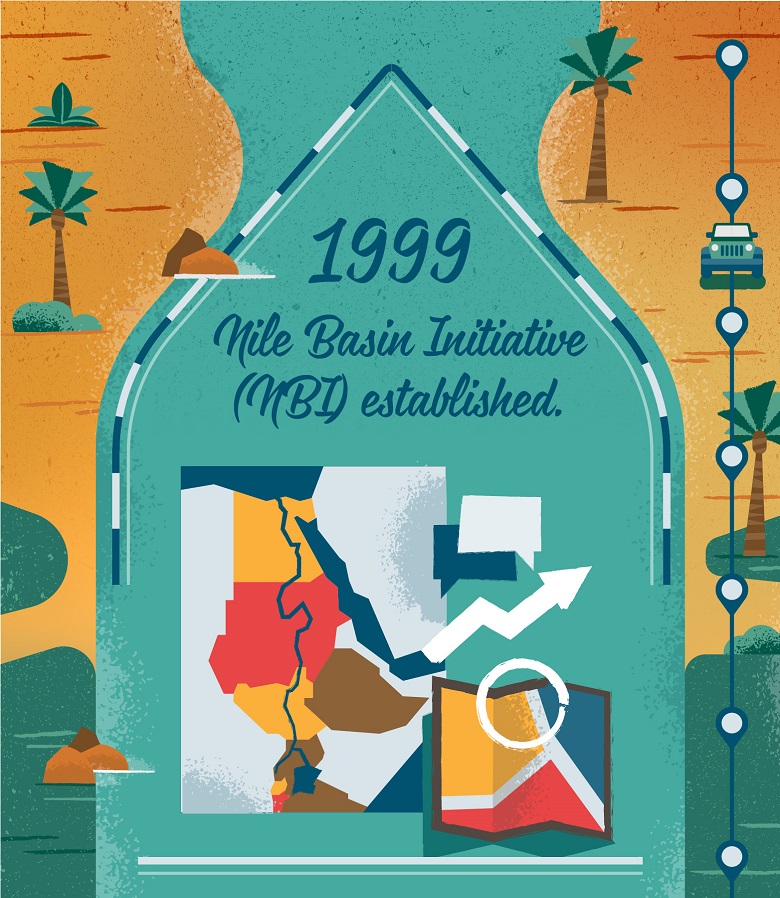 |
Figure 1: Establishment of NBI Source: Worldbank |
1999: Nile Basin Initiative (NBI)
The NBI was formed in February 1999 in order to bring about sustainable development of the Nile River in addition to cooperation between its riparians. This initiative was facilitated by the World Bank and the United Nations Development Programme. Upon formation, all of the then 9 Nile Basin countries became members, the goal being the cooperative development of the river which would promote peace and security in the region and allow the countries to share substantial socio-economic benefits (El Dahan, 2018). Following independence, South Sudan has been an addition to the initiative. Eritrea participates as an observer. One of the main goals of the initiative has been to establish a Cooperative Framework Agreement (CFA) to replace earlier bilateral treaties which were inequitable (Paisley). Another aim was to formalise the NBI into a permanent Nile River Basin Commission (Paisley). Work started and continued for 10 years to create a CFA which all riparians could view as acceptable. However, by 2009 an impasse had been reached as some of the basic issues were still persisting due to the riparians having wildly differing viewpoints (Salman, 2017). These could not be resolved.
 |
Figure 2: flags of the member countries of the NBI Source: Ahram online |
2010: Entebbe Agreement/ Cooperative Framework Agreement (CFA)
The CFA is also known as the Entebbe Agreement. In may 2010 in Entebbe, Uganda, the Nile CFA was signed by 4 upper riparian countries: Ethiopia, Rwanda, Tanzania and Uganda (Seide, 2014). Kenya signed 5 days later, whilst Burundi joined in February 2011. Both Egypt and Sudan refused to sign and froze their membership in the NBI arguing that the deal reallocated their water shares without their approval (El Dahan, 2018). The Entebbe Agreement would allow the other basin countries to construct projects on the Nile without the consent of Egypt and would prohibit Egypt from using its veto power acquired in the colonial treaties (Salman, 2017). Egypt and Sudan continue to reject the CFA.
Below is a video from KTN News Kenya reporting on the country signing the agreement:
2015: The Declaration of Principles (DoP)
The upper riparians did not let this impasse of the CFA or the breakdown of the NBI stop them and continued with their developments on the Nile, including the building of the Grand Ethiopian Renaissance Dam (GERD). This has been a serious source of contention between Egypt, Ethiopia and Sudan. However, in 2013 and 2015, first Sudan and then Egypt declared their support for the project. This was a significant step, resulting in the Agreement on Declaration of Principles on the GERD (El Dahan, 2018). The 3 countries agreed to cooperate, understanding the needs of both upstream and downstream riparians. Egypt and Sudan have accepted equality of all the riparians, outlined by the international water law of equitable and reasonable utilisation (Salman, 2017). The DoP was confirmed in December 2015 by the signing of the Khartoum Document.
Concluding comments
The signing of the Khartoum Document is a big step towards peaceful cooperation in the Nile Basin showing a more positive angle to a topic that tends to be dominated by conflict and negative news stories. Despite its setbacks, the NBI has also been a success, celebrating its 20 year anniversary in 2019 (Figure 3). It has helped Nile Basin countries to negotiate and prepare 30 projects with shared benefits throughout the region, bringing positive change to millions of lives (Worldbank, 2019). However, the Khartoum Document only deals with the GERD project on the Blue Nile, it does not tackle the broader problems of the sharing of the Nile waters between all the riparian countries. This leaves the conflict over the allocation and utilisation of the Nile River unresolved amid ever increasing demand for water resulting from population and economic growth.
 |
Figure 3 - 20 year anniversary of NBI Source: Worldbank |


I like the way this is structured and links to your previous post. Your passion for the topic comes through here well. Excellent!
ReplyDeleteI've always been interested in politics in this region and all the research I have done to get ideas for this blog has increased my passion even more so I am pleased this came through to you in my writing!
DeleteThis piece was very easy to follow and informational - especially when considering I had absolutely no background knowledge regarding this topic. Kudos Carmen!
ReplyDeleteThis can be quite a confusing topic to learn about as there are so many different agreements and treaties and documents so it took a while to turn all the information into a piece that was easy to understand. So I'm glad that I achieved my aim and you found it easy to follow along with no background knowledge!
Delete