GERD - Power to Ethiopia!
The focus of this blog will be on the Grand Ethiopian Renaissance Dam (GERD), a project in Ethiopia (Figure 1) which I remember hearing about and seeing on various news outlets whilst growing up. During my research into the water politics of the Nile Basin, I immediately came across this project, subsequently realising how it is a major source of contention between the riparian countries. Before going into the details of the project, I would like to point out how the dominance of Egypt and Sudan as consumers and Ethiopia as the primary supplier is crucial to understanding the region. Despite there being 11 riparian countries, these 3 are the most pivotal in establishing the cooperative sharing of the Nile Waters (Ashebir, 2009).
Recent Developments
In July 2020, Ethiopian officials announced that the first stage of the filling of the GERD was complete and that by 2023 its full power generating capacity will be achieved (Meseret, 2020). These recent developments in the extremely controversial project have caused a spike in the tensions between Ethiopia and Sudan on one side (the downstream riparians and dominant consumers) and Ethiopia (the primary supplier) and the upstream riparians on the other (Mbaku, 2020). Eygpt has called for the international community to get involved as the actions of the Ethiopians violates Egypts mandate that the dam cannot be filled unless there is a legally binding agreement on the equitable allocation and utilisation of the Nile (Mbaku, 2020). The US has threatened that if another impasse is reached and the conflict remains unresolved then they may withhold aid to Ethiopia (Gramer, 2020). The Egyptian President, Abdel Fattah al-Sisi, has also hinted that military force could be used to halt the project (Gramer, 2020). This highlights the scale of the geopolitical tensions that this water project has caused and its threat to the political stability of the region.
 |
Figure 1: Location of GERD Source: El-Nashar and Elyamany, 2018 |
What is the GERD
The Grand Ethiopian Renaissance Dam will be the largest Dam on the African continent, behind which will be an enormous reservoir (Figure 2). Ethiopia plans to use both of these element to support agricultural development and to provide much needed electricity to a large amount of its population, as about 80% of the population lacks access to electricity (Figure 3). Construction of the $4.6 billion project began in April 2011, aiming to be completed by 2017 (NSenergy, 2021). Setbacks and delays have resulted in the dam being only two thirds built by the start of 2020. It will be able to store about 74 billion cubic metres of water. To help understand the scale of this project, the GERD is projected to produce over 3 times more electricity per year than the Hoover Dam in the USA.
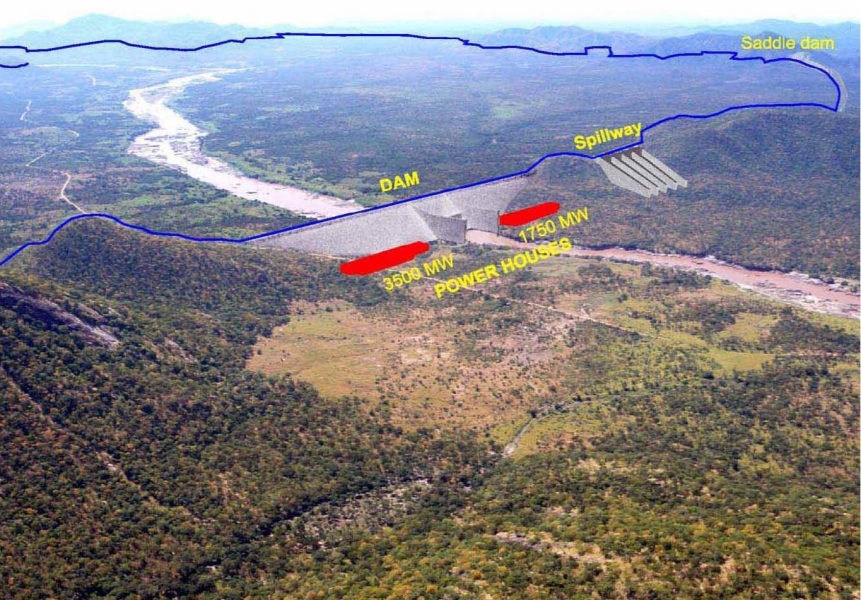 |
Figure 2: The GERD. The blue outline shows the size of the planned reservoir Source: International Rivers |
Here is a video outlining some of the key reasons for the disputes over the GERD:
Benefits
As the primary supplier of the Nile flow, Ethiopia wants to use its water to aid the development of the country, in order to bring power to the nation, create economic growth and cause a reduction in poverty. On the United Nations Human Development Index ranking list, Ethiopia was positioned as 173rd poorest out of 187 countries (undp, 2018). The country has developed less than 3% of its hydropower potential and 5% of its irrigable land (Higdon, Sheehan and Eskew, 2020). The construction of the dam will provide Ethiopia with the opportunity to harness the full potential of its hydropower to fuel agriculture and its economy, thus reducing poverty. If completed, the dam will generate approximately 15,0000 gigawatts of electricity per year; a 200% increase in available electricity (NSenergy, 2021).
 |
Figure 3: The white spots show electricity use. Shows the lack of electricity in Ethiopia and the upper riparians compared to Egypt and Sudan to a lesser extent
Source: Higdon, Sheehan and Eskew, 2020
Not only will the damn benefit Ethiopia, but also other countries in the basin. One of the main positive impacts will be the reduction in unexpected flooding in the downstream countries such as Egypt and Sudan as the dam will be able to regulate the flow of water downstream. Additionally, evaporation causes Lake Nasser to lose about 10% of its water every year (El-Nashar and Elyamany, 2018). The GERD will decrease the active storage of Lake Nasser, therefore, reducing the amount of water lost due to evaporation.
In this post I have outlined how Ethiopia will benefit from the GERD, however, there is another side to the story. The construction of a dam this size does not come without negative impacts. In my next blog I will look at the opposition to the dam within the basin, especially by Egypt, as well as some of the negative impacts experienced in Ethiopia on the local scale.


Comments
Post a Comment